What is a Change in State of Delivery (CISD)?
Change in State of Delivery (CISD) is an ICT concept describing the moment an algorithm shifts from delivering price in one direction to delivering it in the opposite direction. Unlike a regular Break of Structure (BOS) — which simply identifies a new high or low — a CISD specifically marks the algorithmic transition point and is identified by a full candle body closing beyond a prior swing point after a liquidity sweep. Many traders confuse CISD with BOS or CHoCH; the distinction is that CISD requires confirmation that the delivery algorithm itself has changed, not just that price moved.
Key Stat: CISD is confirmed when: (1) a liquidity pool above or below price is swept, (2) a displacement candle closes fully beyond the prior swing, and (3) a Fair Value Gap is created in the displacement move.
While basic Market Structure Shifts (MSS) are taught widely, advanced ICT traders look for something more precise: a Change in State of Delivery (CISD). This concept is crucial for identifying exactly when institutional pricing algorithms switch from seeking buy-side liquidity to sell-side liquidity.
The Mechanics of CISD
To understand a CISD, you first need to understand how the market delivers price. A "state of delivery" refers to the current direction the algorithmic market maker is repricing an asset.
If the market is continuously creating down-close candles to reach a lower pool of liquidity, it is in a bearish state of delivery.
A Change in State of Delivery occurs when price violently reverses and breaks through the last opposing closed candle. For a bullish CISD, you want to see a strong impulsive move upwards that completely engulfs and closes above the last down-close candle (which is essentially an Order Block).
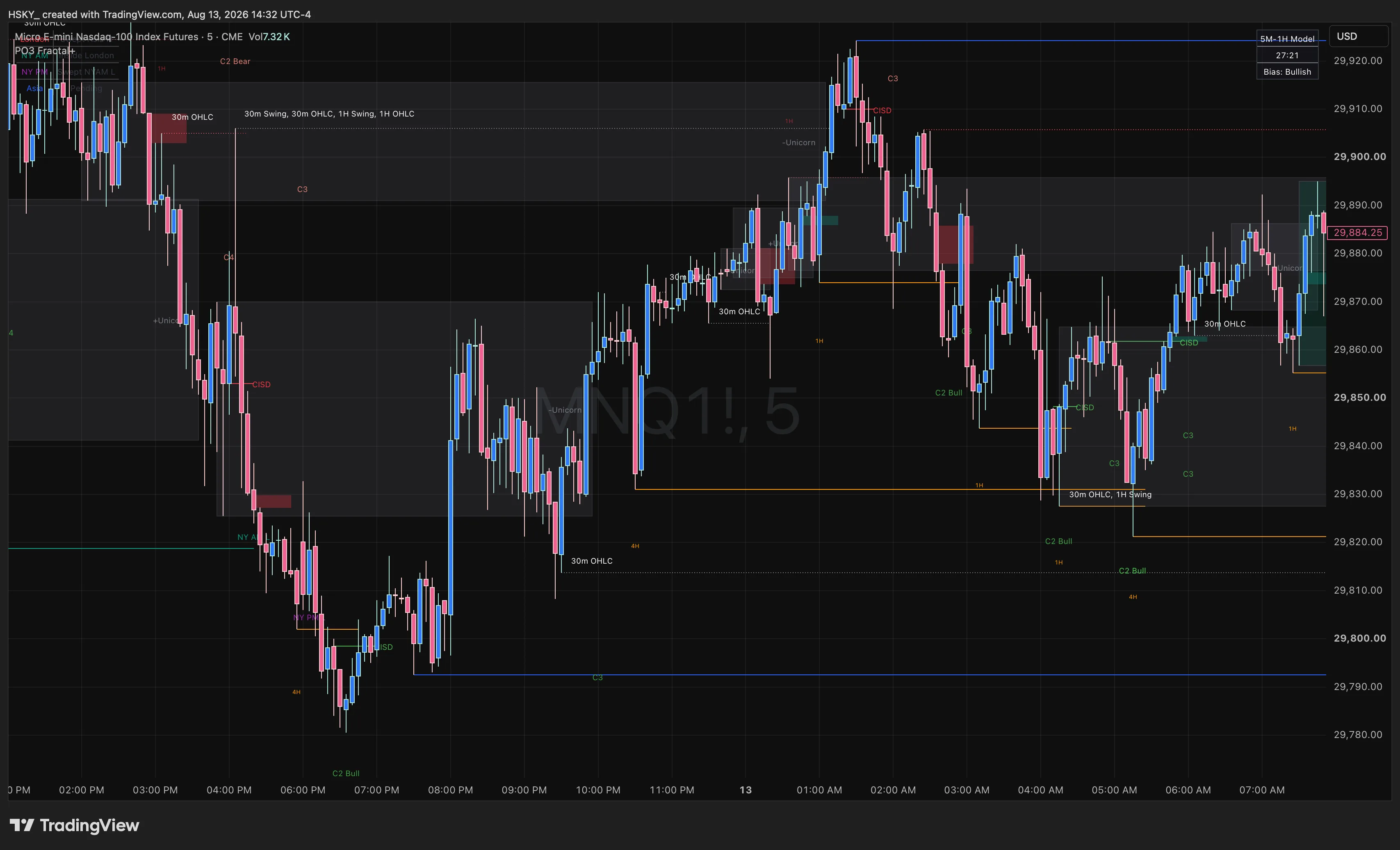
CISD vs. Standard Market Structure Shift
A standard Market Structure Shift requires price to break above a previous swing high. A CISD happens before the swing high is broken.
It is an internal shift. Because it happens on the internal candle structure, it provides a much earlier entry signal than waiting for a full swing high break.
The Ultimate CISD Setup
The highest probability CISD setups always occur immediately after a Liquidity Sweep. If the market sweeps sell-side liquidity into a higher timeframe support zone, and then instantly produces a bullish CISD on the 1-minute chart, you have a perfect, high-conviction institutional entry.
Related Reading:
Need to brush up on what happens when a CISD forms around an Order Block? Review our guide: What is an Order Block in Trading?
Skeptics ask whether CISD is predictive or decorative. The answer from 11,100 backtested NQ trades: 98.1% of CISD signals resolve in the signaled direction within 30 bars.
Bearish CISDs are particularly violent — in 5 of 6 backtesting runs, short signals generated materially more profit than long signals, because downside institutional displacement reaches target faster.
Automate Advanced ICT Concepts
Don't second guess your analysis. HSKY Suite maps out the exact institutional narrative, from liquidity sweeps to state changes, completely hands-free.
Get HSKY Suite Today